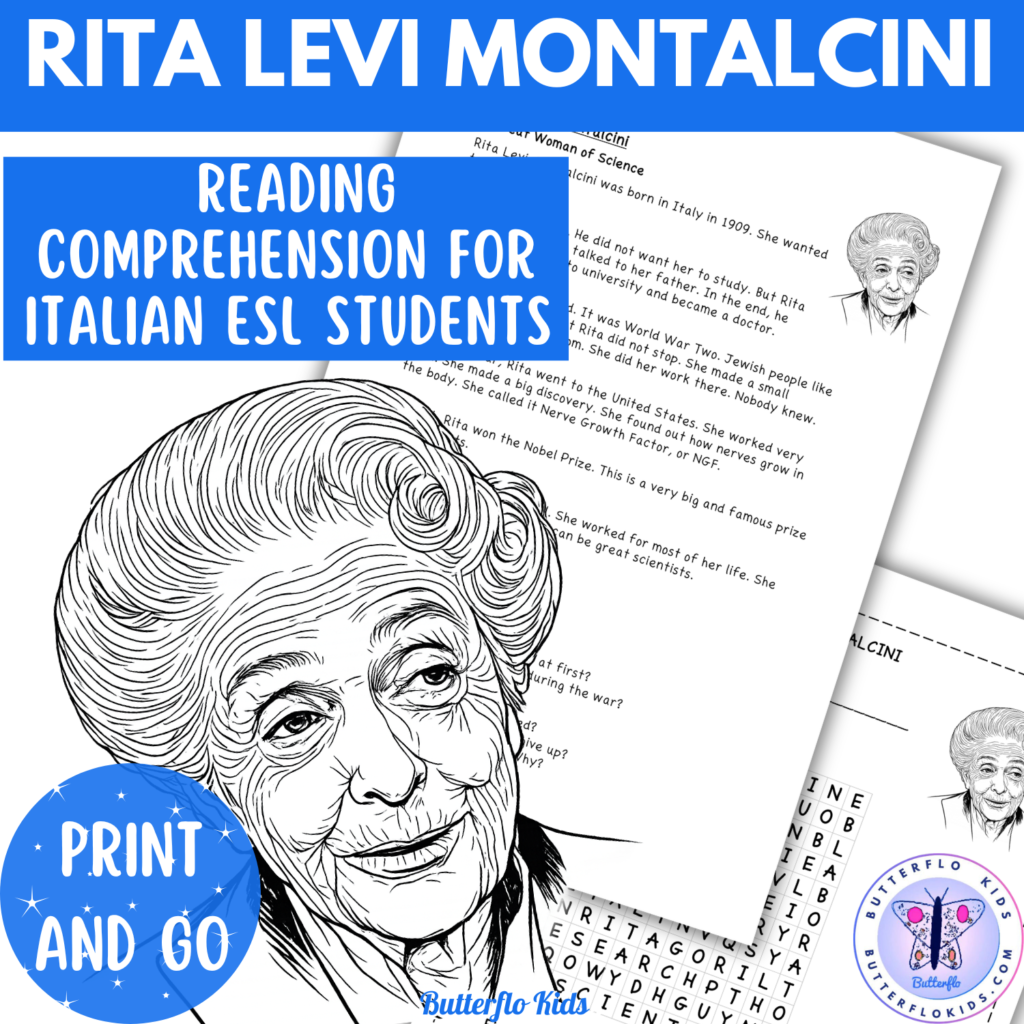
Reading Comprehension Lesson on Rita Levi-Montalcini
Are you looking for an engaging, low-level reading comprehension lesson that inspires your students? This ready-to-use lesson about Rita Levi-Montalcini is exactly what you need. It is perfect for ESL teachers, EFL teachers, ELA teachers, and homeschool parents working with beginner to lower intermediate English learners.
Who Was Rita Levi-Montalcini?
Rita Levi-Montalcini was an Italian scientist born in Turin in 1909. She is one of the most inspiring women in the history of science. Despite facing huge obstacles, including a father who did not want her to study and the horrors of World War Two, she never gave up.
She went on to discover Nerve Growth Factor (NGF), a protein that helps nerves grow in the body. In 1986, she won the Nobel Prize in Medicine. She lived to be 103 years old and worked almost until the very end of her life.
Her story is simple, powerful, and true. It teaches children that hard work, courage, and determination can take you anywhere. She is a wonderful subject for a biography reading lesson, a Women’s History Month activity, an International Women’s Day resource, a science biography unit, or an Italian heritage study.
What Is Included in This Lesson?
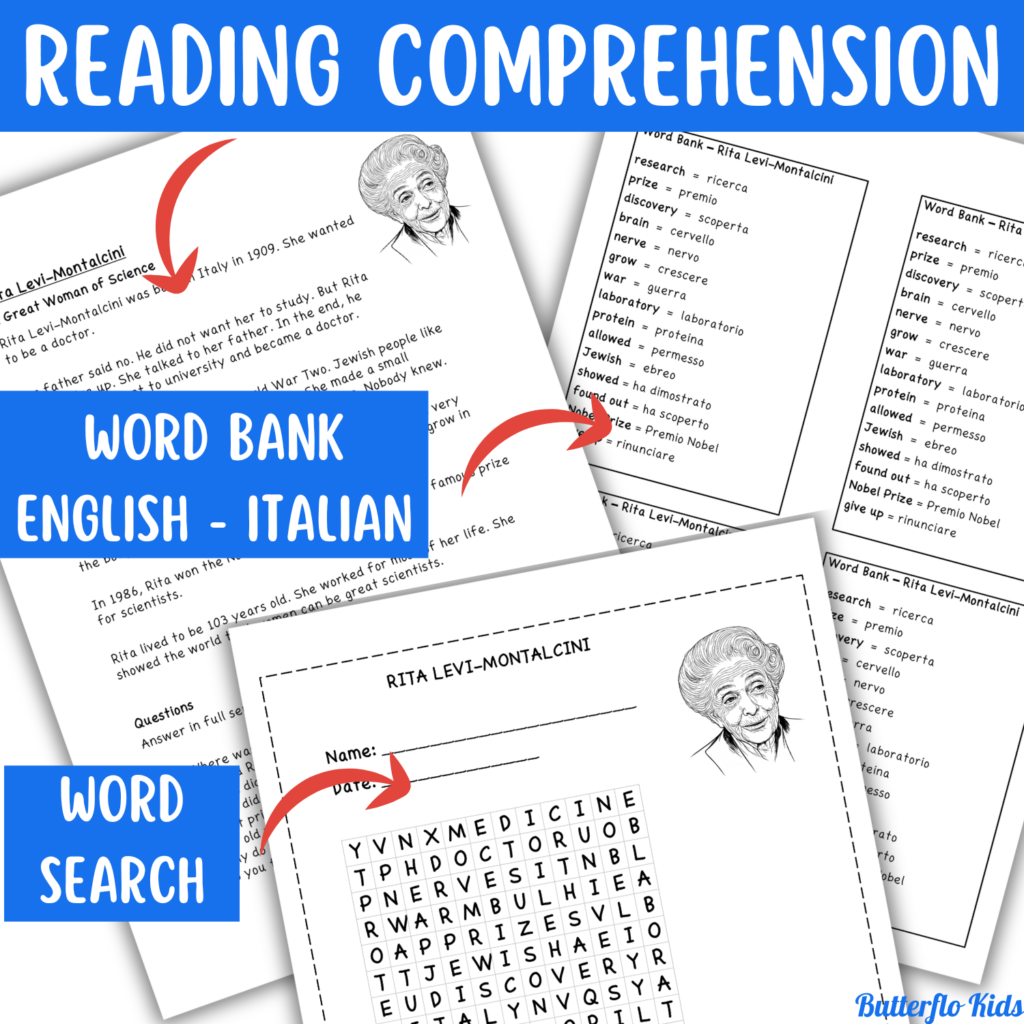
This complete lesson pack includes everything you need in one simple, print-and-go document.
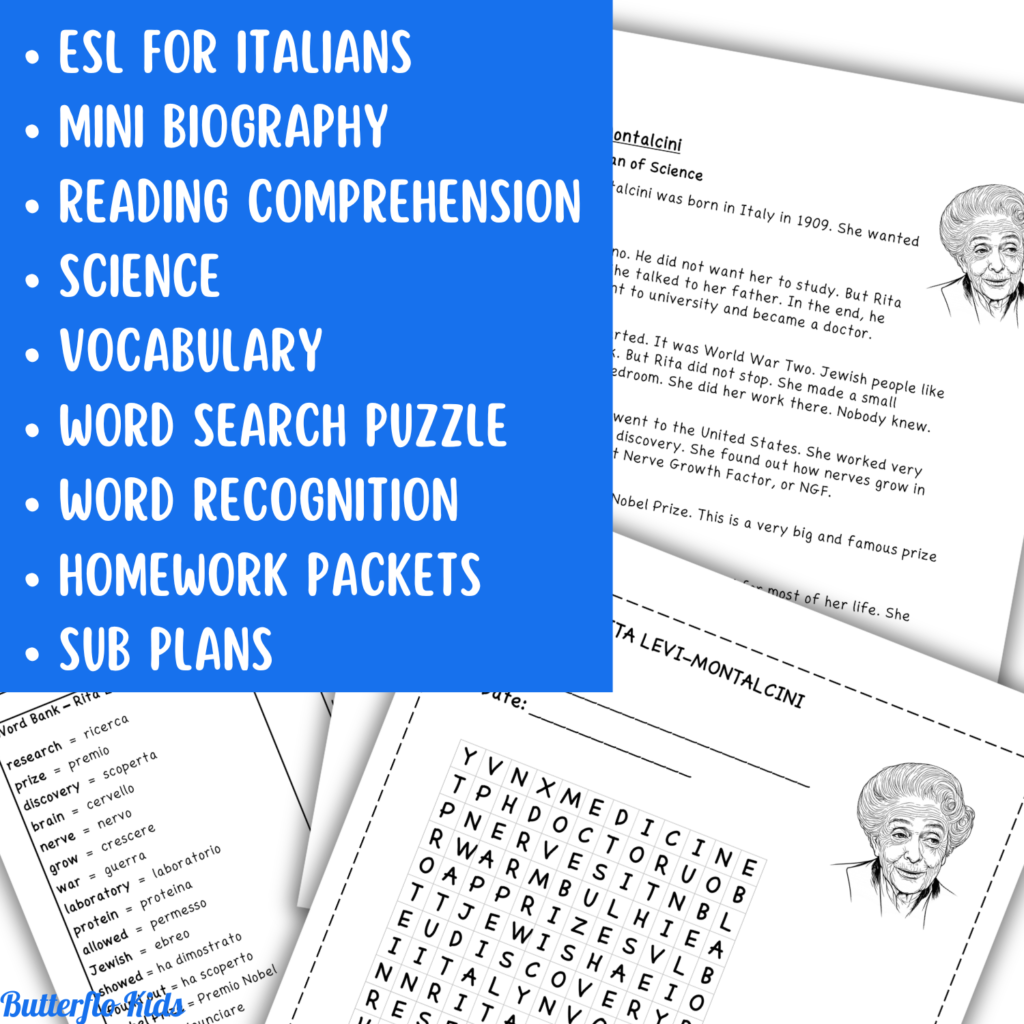
A short non-fiction reading passage.
It uses short sentences, simple vocabulary, and a clear structure so that Italian ESL learners can access it with confidence.
8 reading comprehension questions.
The questions practise a range of skills including finding key information, identifying the main idea, sequencing events, making inferences, and expressing opinions. The last two questions are open-ended, giving students a chance to think critically and share their own ideas in English.
A bilingual vocabulary list.
The word list includes 15 key words from the text with their Italian translations. This is especially helpful for Italian ESL learners who can use their first language to support their understanding of new English words.
A word search puzzle.
The word search includes 15 important vocabulary words from the lesson. It is a fun and engaging way to reinforce topic vocabulary and help students remember key words from the text.
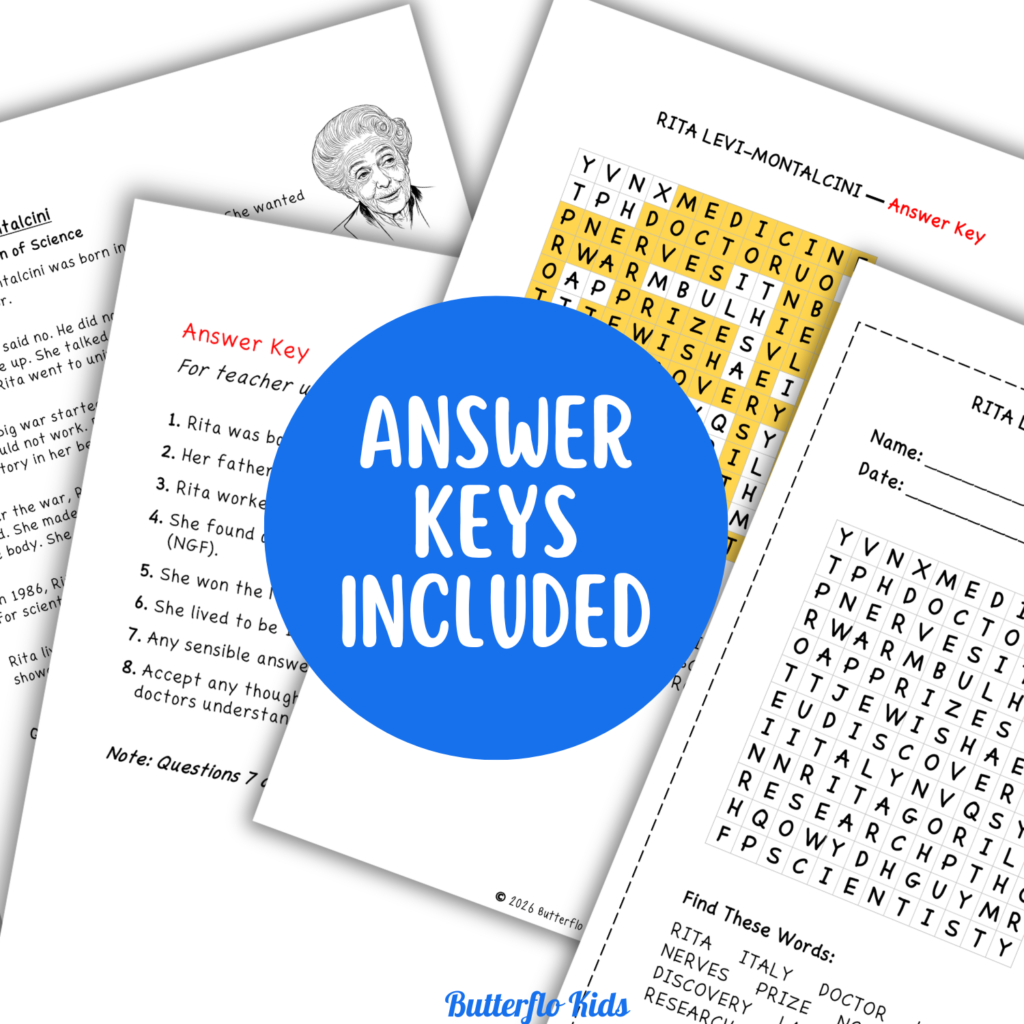
A full answer key.
The teacher answer key includes suggested answers for all 8 questions and clear guidance on how to mark the open-ended questions. No preparation needed.
Who Is This Lesson For?
This lesson is designed for ESL students, ELL students, English language learners, and beginner readers aged 7 to 11. It works well in ESL classrooms, EFL classrooms, ELA lessons, primary school science lessons, homeschool settings, and as a fast-finisher or substitute teacher activity.
Because the text is short and the language is simple, it is also suitable for older students with low English levels, including upper primary and lower secondary learners who need a confidence boost with reading in English.
What Skills Does This Lesson Cover?
This lesson targets a wide range of literacy and language skills that are important for young English learners.
Reading skills:
Finding the main idea, identifying key details, understanding the sequence of events in a person’s life, making inferences, and reading non-fiction text.
Writing skills:
Writing answers in full sentences, expressing opinions, and using evidence from the text.
Vocabulary skills:
Learning new topic words, using context clues to work out meaning, and practising key words through the word search activity.
Why Teach About Rita Levi-Montalcini?
Rita’s story is one of the most remarkable true stories you can share with young learners. She is a real role model for girls and boys alike.
She shows students that it is possible to succeed even when people tell you no, even during a war, and even when the world seems against you.
Teaching about famous women in science is a powerful way to inspire your students and broaden their view of what is possible.
Rita Levi-Montalcini belongs alongside Marie Curie, Rosalind Franklin, and Ada Lovelace as a scientist every child should know about.
This lesson fits beautifully into Women’s History Month in March, International Women’s Day on 8th March, Science Week, STEM learning, biography and non-fiction reading units, and any lesson about inspiring people or famous Italians.
Tips for Using This Lesson in Your Classroom
Here are a few ideas to get the most out of this resource.
Before reading: Show students a map of Italy and ask if anyone knows any famous Italian people. Introduce the word scientist and ask students what scientists do.
During reading: Read the text together as a class or in pairs. Encourage students to use the vocabulary list to help them understand difficult words as they read.
After reading: Students answer the comprehension questions independently or in pairs. Use the open-ended questions as a class discussion starter.
Extension activity: Ask students to write two or three sentences about a person they admire who never gave up.
Word search: Use the word search as a warm-up activity, an early finisher task, or a fun homework activity to reinforce vocabulary.
Download This Lesson Today
This no-prep, print-and-go ESL reading comprehension lesson is simple to use and ready to go the moment you download it.
Whether you are an ESL teacher, an EFL teacher, an ELA teacher, or a homeschool parent, this resource will save you time and give your students a meaningful and memorable reading experience.
Inspire your students with the true story of a woman who changed science and never stopped believing in herself.